- - - -
Last updated 18th Jun 13

MANAGED BY:
CHATHAM HOUSE FINANCED BY:
UKaid logo

This material has been funded by UKaid from the Department for International Development, with additional support from the European Forest Institute's EU FLEGT Facility. The EU FLEGT Facility is funded by the European Union, the Governments of Finland, France, Germany, the Netherlands and the United Kingdom, and the European Forest Institute. However the views expressed do not necessarily reflect the official policies and views of either DfID or EFI.

home _ news
- - - -

US-Peru bilateral to address illegal logging, boost MEA implementation


Civil society groups in the US are lauding a newly-revised version of the US-Peru free-trade agreement as the first bilateral trade treaty to recognise and seriously address the problem of illegal logging.

In the area of environment, the US-Peru FTA has been amended through the inclusion of new and significantly strengthened provisions, as well as through the addition of a new annex on forest sector governance.

After the US Democratic Party took control of Congress in late 2006, it negotiated a new framework on trade policy with the current administration, requiring revisions to already-agreed free-trade agreements (FTAs) between the US and some of its trading partners (see Bridges Trade BioRes, 25 May 2007, http://www.ictsd.org/biores/07-05-25/inbrief.htm#2). Among the changes, labour and environmental requirements of 'best-endeavour' sort have now been elevated to core obligations subject to dispute settlement, and several patent-related intellectual property rules have been relaxed (see Bridges Weekly, 4 July 2007 http://www.ictsd.org/weekly/07-07-04/story2.htm).

Tough measures against illegal logging

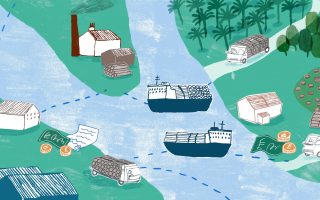
The new annex on forest sector governance in the US-Peru FTA contains a number of detailed and mandatory provisions to address illegal logging as well as illegal trade in wildlife. Among implementation measures, Peru will develop systems to track Convention on International Trade in Endangered Species of Wild Fauna and Flora (CITES)-protected tree species from the harvesting stage through transport, processing and export. The annex includes set time periods and provisions for verification and action against traders in case of non-compliance. Peru is also obliged to identify a focal point, with appropriate and sufficient authority and staff to investigate violations of law and regulations for forest sector governance. The annex further provides for the establishment of a Sub-Committee on Forest Sector Governance under both the Committee on Trade in Goods and the Environmental Affairs Council to facilitate consultation and information exchange.

Under the forest annex, Peru is expected to craft, adopt and make the financial resources available for implementing a strategic plan of action on broad-leaf mahogany in order to comply with CITES. Broad-leaf mahogany is listed in Appendix II of CITES, meaning its trade is regulated and severely restricted. Among key measures, Peru is to establish an annual export quota for broad-leaf mahogany, as proposed in the CITES context (see Bridges Trade BioRes, 22 June 2007 http://www.ictsd.org/biores/07-06-22/story2.htm). Peru is the world's number one exporter of mahogany, and the US the main importer.

The forest annex allows the US to detain questionable shipments pending verification that the timber was legally harvested. A Geneva-based expert noted that, with regard to inspections that US authorities will be able to undertake, Peruvian authorities have not been provided reciprocal access.

According to the expert, a number of measures in the forest annex would require changes in Peruvian legislation, including the penal code. He acknowledged that civil society pressure in the US was key in the formulation of the forest annex, but stressed the need to recognise 'realities' on the ground. He stressed the need to enhance Peru's capacity, as current capacity for enforcing the measures over wide forest areas was just not adequate.

The two parties will to review the operation of the forest annex three years after the agreement enters into force.

Peru, US list key MEAs

The environmental chapter of the revised US-Peru FTA contains requirements for the parties to fulfil their obligations under a set of Multilateral Environmental Agreements (MEAs) that have been ratified by both parties: CITES, the Montreal Protocol on Substances that Deplete the Ozone Layer, the International Convention for the Prevention of Pollution from Ships, the Ramsar Convention on Wetlands, the Convention on the Conservation of Antarctic Marine Living Resources, the International Convention for the Regulation of Whaling and the Convention for the Establishment of an Inter-American Tropical Tuna Commission. Absent from the list are the Convention on Biological Diversity, not signed by the US, and the UN Framework Convention on Climate Change.The list is open to modification in the future.

Prior the recent revision, the environmental chapter of the US-Peru FTA only committed parties to enforcing their own domestic environmental laws while 'enhancing the mutual supportiveness of MEAs and international trade agreements' to which both are parties.

Weak language on biodiversity, traditional knowledge

While the revised US-Peru agreement places enforceable obligations on Peru with regard to forest governance, parties merely 'recognise' the importance of conservation and sustainable use of biological diversity and their role in contributing to sustainable development. Similar 'soft' language is included on traditional knowledge, with parties 'recognising' the importance of respecting and preserving traditional knowledge and practices of indigenous and other communities that contribute to conservation and sustainable use of biodiversity.

With regard to environmental cooperation, the US and Peru likewise simply declare at a general level their commitment to undertake activities pursuant related to the chapter's implementation.

FTA sets us trade policy on 'new course' say NGOs

Civil society groups -- including the Sierra Club, Friends of the Earth International, Earthjustice, Centre for International Environmental Law -- welcomed the new provisions in the revised US-Peru FTA, commending the Democratic leadership and stating that the revisions should be the starting point for setting US trade policy 'on a new course.' The groups, which had previously strongly criticised the US-Peru FTA, said, however, that the deal did not provide a final template for trade deals generally. They added that much work remained to be done on investment and other trade provisions to ensure that they strengthened rather than undermined environmental protection in the US and abroad.

On 28 June, Peru's Congress approved the new FTA text with 70 votes in favour, 38 against and one abstention. According to a trade source, the US is likely to seek ratification only after Peru has made domestic legislative changes to comply with the revised FTA.


edited:16/07/2007
uploaded:07/07/2007
ARTICLE DETAILS
DATE

06/07/2007

AUTHOR

Bridges Trade BioRes

RELATED AREAS